
Fedora Silverblue
Contents
Official Fedora packages are maintained by Fyra Labs, the creators of Ultramarine Linux, in Terra repository: they are part of OGC as asus-linux is.
WARNING The page will not be updated directly by the core team; this guide has been updated by the community on Discord. If there are any issues with the Fedora documentation, feel free to contribute.
If you are installing on a Zephyrus G14 (2022), there is a guide here which has lots of information.
Read the Intro guide first to avoid bad surprises.
Installation
The user may exercise their own discretion with the options given, however be sure to decline the enabling of "third-party" repositories.
Enabling the Terra Repository
ASUS Linux packages and tools are currently packaged on the Terra Repository for Fedora. Add the Terra repo with the following commands:
curl -fsSL https://github.com/terrapkg/subatomic-repos/raw/main/terra.repo | pkexec tee /etc/yum.repos.d/terra.repo
rpm-ostree install --apply-live terra-release
Asusctl
This section covers installing asusctl and its supporting software. This enables controls for the Asus ROG hardware on the laptop.
rpm-ostree install asusctl
To avoid problems with tuned, you should use ppd.
rpm-ostree override remove tuned-ppd --install power-profiles-daemon
ROG Control Center
ROG Control Center is a GUI tool for configuring few aspects of asusctl and supergfxctl. It was previously part of the asusctl package, but has now been separated as its own package in G14 repo. After adding the Terra or COPR repository as described above, you can now install the tool:
rpm-ostree install asusctl-rog-gui
Reboot your system to apply the changes
Once the asusd and supergfxd services have been restarted, they should be enabled by default. If this is not the case, you can enable them as follows:
systemctl enable --now asusd.services       # Required for asusctl
systemctl enable --now supergfxd.services   # Required for supergfxd
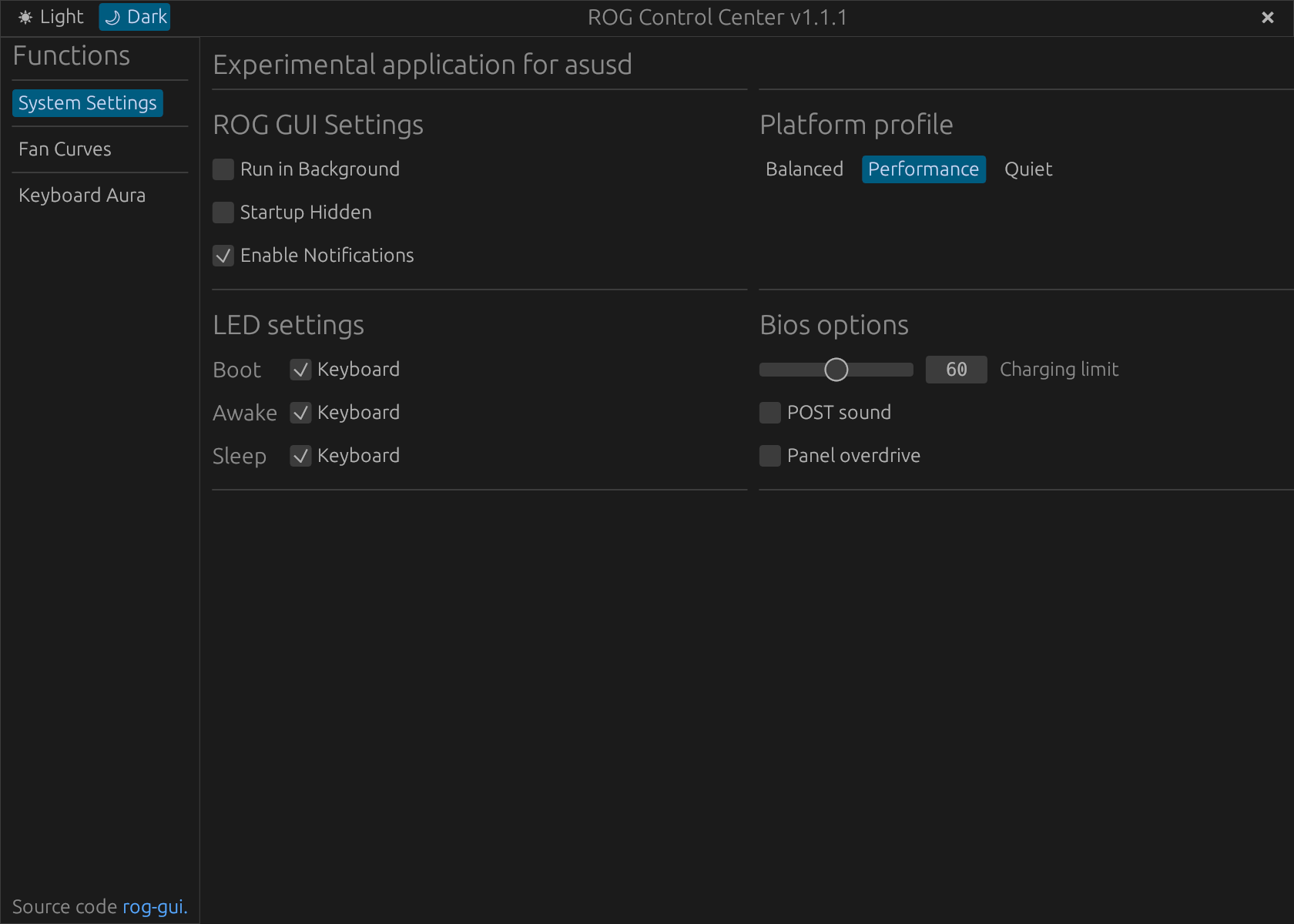
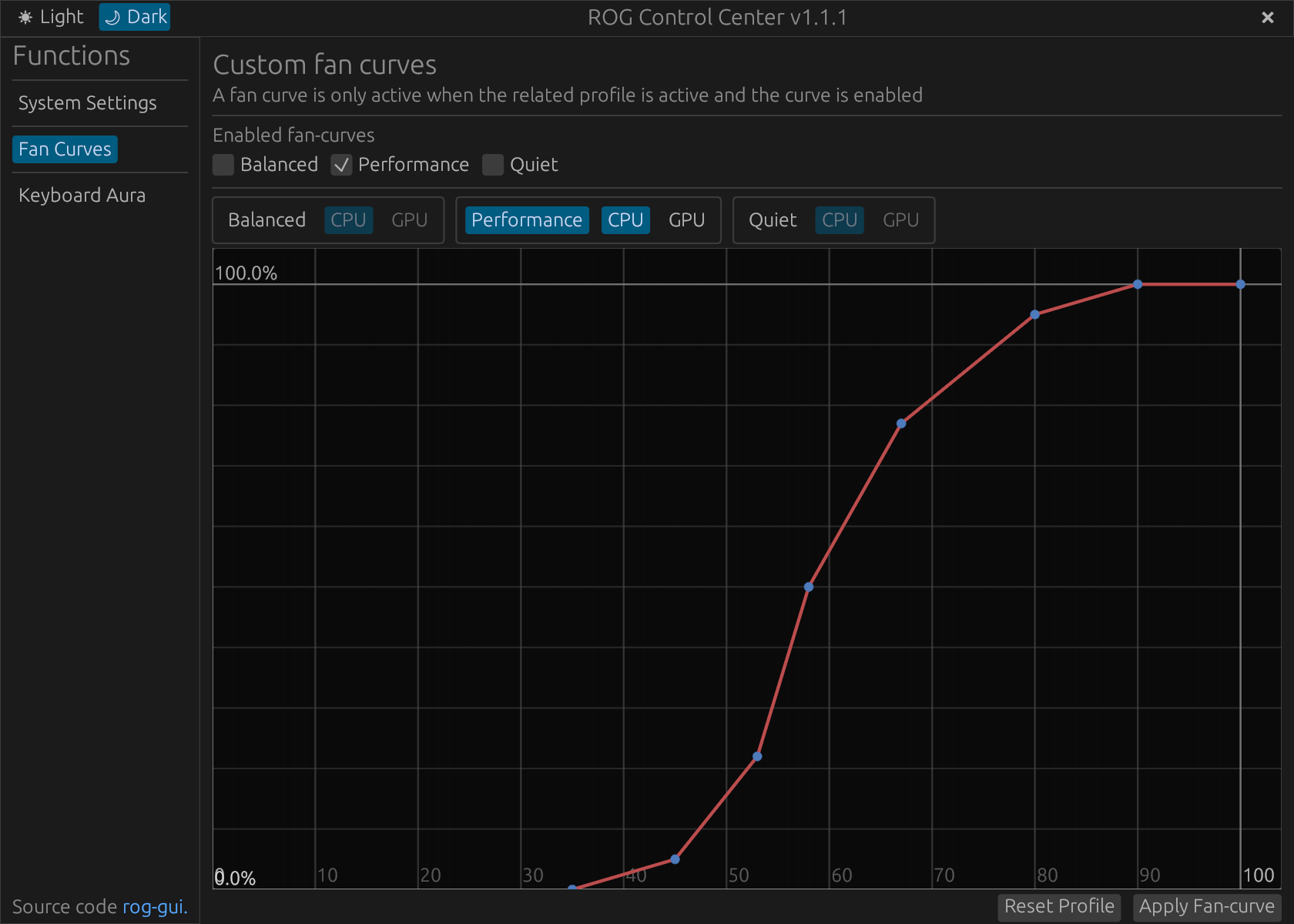
Note: ASUS releases new products every year, so it is not possible to guarantee that everything will work on the current Fedora vanilla kernel. For this reason, depending on your device, you may require a kernel that has the latest patches such as ASUS Armoury (this driver will be available in Linux 6.19 and later versions) or similar, for example, CachyOS Kernel (at least until the OGC kernel is ready). However, depending on your case and your needs, this may be optional. Read Custom Kernel.
Optional Steps
Installing RPM Fusion
Usually, when you enable third-party repositories, RPM-Fusion is enabled automatically. However, if it is not, you can follow this guide.
sudo dnf install https://mirrors.rpmfusion.org/free/fedora/rpmfusion-free-release-$(rpm -E %fedora).noarch.rpm https://mirrors.rpmfusion.org/nonfree/fedora/rpmfusion-nonfree-release-$(rpm -E %fedora).noarch.rpm
Hardware Accelerated codecs
The Atomic versions of Fedora do not include codecs in the system image, because these distros are focused on modifying as little as possible to ensure stability. It is recommended to use Flatpak, Distrobox, Toolbox, or any other type of container, as these do not share codecs with the system and prevent you from having to install them. However, if you want to install them, you can follow this guide but remember install RPM-Fusion repos first.
Universal Blue and its images already include the codecs in the system, so it is not necessary to perform these procedures.
Supergfxctl - DEPRECATED
WARNING supergfxctl is being phased out and its use is unadvised. During this transitioning period where an alternative is unavailable, unless you require vfio for virtual machines or have problems turning off your dGPU don't install it!
WARNING Read the supergfxctl manual first!
The same steps as for asusctl, installing:
rpm-ostree install supergfxctl
supergfxctl can be used without asusctl.
Flatpak Cleaning
In order to streamline our dependency on flatpak it is worthwhile to have everything working with the same fundamentals.
flatpak remote-delete fedora
flatpak remote-add --if-not-exists flathub https://flathub.org/repo/flathub.flatpakrepo
The steps above will uninstall the packages from the Fedora remote, so the following command will install the Flathub versions instead (Apply only on Silverblue version).
flatpak install org.gnome.Calculator org.gnome.Calendar org.gnome.Characters org.gnome.Connections org.gnome.Contacts org.gnome.Papers org.gnome.Logs org.gnome.Loupe org.gnome.Maps org.gnome.NautilusPreviewer org.gnome.Snapshot org.gnome.Weather org.gnome.baobab org.gnome.clocks org.gnome.font-viewer org.gnome.Showtime org.gnome.TextEditor org.gnome.Decibels
Replace Firefox RPM with Flathub Flatpak and Force Wayland
rpm-ostree override remove firefox firefox-langpacks
flatpak install flathub org.mozilla.firefox org.freedesktop.Platform.ffmpeg-full
Nvidia
Nvidia in Atomic versions requires key enrollment. However, you may need to repeat this process after an update, although you can use this, so below you will find two options.
Recommended approach
The recommended approach is to use or rebase Bazzite Bluefin, AuroraOs, or a vanilla image of Universal Blue with the Nvidia driver already configured.
If you want rebase follow this guide.
Manual approach
If you are unable or unwilling to use the method described above, you can follow these steps:
Add RPM-Fusion repos:
rpm-ostree install --apply-live https://mirrors.rpmfusion.org/free/fedora/rpmfusion-free-release-$(rpm -E %fedora).noarch.rpm https://mirrors.rpmfusion.org/nonfree/fedora/rpmfusion-nonfree-release-$(rpm -E %fedora).noarch.rpm
Note: If your laptop has an NVIDIA card older than Turing, the repo to install is Negativo17.
Install Nvidia drivers:
rpm-ostree install akmod-nvidia xorg-x11-drv-nvidia xorg-x11-drv-nvidia-cuda
rpm-ostree kargs --append=rd.driver.blacklist=nouveau,nova_core --append=modprobe.blacklist=nouveau,nova_core
Custom Kernel
Custom kernels are not signed, although you can sign them manually, but you would have to do with each new update. Therefore, it is advisable to use another distro such as ArchLinux, CachyOS, or Fedora Workstation (in this case, you can follow the guide to install the CachyOS kernel). If for some reason you need to use a custom kernel such as CachyOS, follow the steps in its COPR and refer to the guide for signing the kernel or you can also disable Secure Boot.
Disable Secure Boot
WARNING Remember that disabling secure boot can cause security issues. Only follow this guide if you are completely sure of what you are doing. It is preferable to use Fedora Workstation with containers and backups with btrfs, or another distro that makes it easy to sign the kernel, such as ArchLinux or CachyOS with sbctl. Proceed at your own risk.
Guide to disable Secure Boot on bios.
